Support
Here you can find various information about our products as a supplement to the information on page Products.
The latest software version for the Serial Diluter is available for download under Software.
Instructions


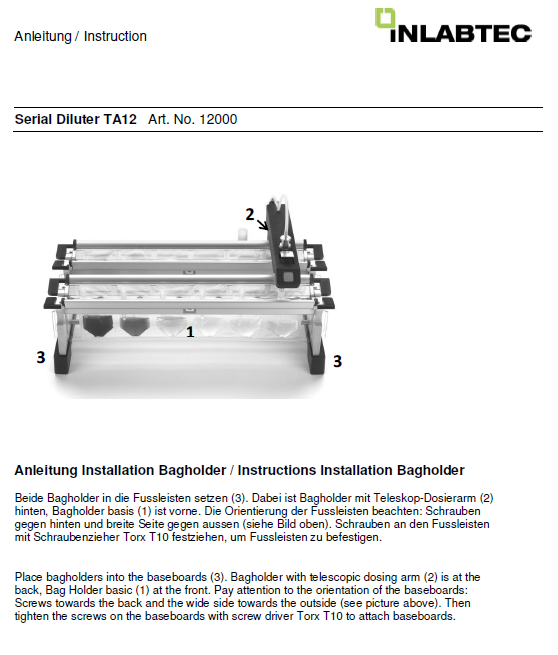
Videos
S





Publications





Software
| Software Serial Diluter Version AP260601 as ZIP file. After extraction transfer file "bag.mhx" on a USB stick (>version 3.0) for the software update. |
|

Questions and Answers
Here you will find answers to common questions about suitability, application, costs, Serial Dilution Bags, sterility, verification, service and sustainability of the Inlabtec Serial Dilution System.
1. Suitability and Benefits
What is the Serial Diluter, and for which laboratories is it intended?
The Serial Diluter is designed for users performing dilutions for the plate count methods in microbiological testing of food, feed, cosmetics, etc.
Which workflow steps are simplified or eliminated?
- Eliminates the time-consuming preparation of dilution tubes.
- Eliminates the need to purchase expensive disposable dilution tubes.
- Accelerates dilution through automation, improving overall efficiency.
- Simplifies handling, reducing the risk of repetitive strain injuries, as automatic mixing eliminates the need to manipulate dilution tubes and lids manually.
For which sample throughput is the Serial Diluter worth using?
As a practical guide, the semi-automatic Serial Diluter UA is suitable for laboratories processing up to around 50 samples per day, while the fully automated Serial Diluter UC is recommended from around 50 samples per day. The economic payback depends on the number of samples, the number of dilution steps per sample, current tube preparation costs, labour costs and consumable prices.
For a first estimate, the savings calculator on Our Solution can be used to check whether the purchase of a Serial Diluter is worthwhile for your laboratory under the given circumstances.
Is the Serial Diluter also suitable for samples that require only one or two dilution steps?
Yes. The Serial Diluter is also suitable for samples requiring only one or two dilution steps.
When six Serial Dilution Bags are inserted, up to six samples with one dilution step or three samples with two dilution steps can be processed before new bags need to be inserted. This keeps handling effort low and supports efficient routine workflows.
What are the benefits of automating dilution procedures in the laboratory?
The Serial Diluter offers efficiency improvements by automating labor-intensive tasks, allowing operators to focus on other responsibilities, and ultimately creating a more positive working environment for laboratory technicians.
Can I use the Serial Diluter without extensive training?
The installation process is straightforward, resembling that of a gravimetric diluter. Our comprehensive support, including training videos, an illustrated manual, and a quick start guide, ensures a smooth transition to the Serial Diluter. While adopting the Inlabtec Serial Diluter may involve a brief adjustment period, the investment proves worthwhile.
How does the Inlabtec Serial Diluter compare with other microbiological dilution methods?
There are several methods available for preparing dilutions in the laboratory, each with its own advantages and disadvantages. Some commonly used methods include dilution tubes prepared by the laboratory, pre-filled disposable dilution containers, the spiral plater, and the Tempo MPN system.
While dilution tubes prepared by the laboratory are an established standard method that most laboratory technicians are familiar with, they can be time-consuming to prepare and require manual skill and good workplace organisation to be efficient and yield correct cell counts.
Ready-made disposable dilution containers may be immediately available and require no preparation, but they come with significant costs for procurement, transport, storage and disposal, as well as a high environmental impact. Additionally, not all diluents may be available, and carrying out dilutions is not always simplified and accelerated.
The spiral plater is well-suited for certain applications without having to dilute the initial sample, such as beverages and milk, and can yield up to 105 CFU/ml and plate. However, it is sensitive to clogging by particles in the sample, requires a high level of flatness for the culture media, and does not support pour plates or dry film media such as Petrifilm or Compact Dry. Additionally, a special counting procedure is necessary for colonies on the plates, and regular maintenance and servicing are necessary.
The Tempo MPN system is a fully automated system for microbial count determination that is ideal for very high throughput and uniform sample types and often manages without additional dilutions. However, it is less accurate than the standard method, and no visual control is possible. It also comes with high operating and acquisition costs, requires significant validation effort per sample type, has a high environmental impact, and requires significant maintenance and service costs. In many workflows, samples may require a 1:100 pre-dilution before use; this dilution step can also be prepared with the Serial Diluter.
In comparison, the Inlabtec Serial Diluter presents a streamlined and automated approach to dilution preparation, combining efficiency with precision. By eliminating inaccurately filled dilution tubes and the need for vortexing, it mitigates the risk of inhomogeneous mixtures, ensuring consistently accurate analysis results. The system’s high flexibility allows it to accommodate various diluents, sample types, and plates. Moreover, the Serial Diluter stands out as an environmentally friendly alternative to disposable dilution containers. Its automated process not only saves time but also enhances productivity, making it advantageous even for laboratories with lower daily sample volumes.
2. Costs and Profitability
What time and cost savings can I expect with a Serial Diluter?
The Serial Diluter reduces routine workload and costs by eliminating tube preparation, washing, autoclaving and separate vortexing, while reducing repetitive manual handling during serial dilution.
Time savings depend on the existing workflow, the number of dilution steps and the operator’s handling routine. In many workflows, automated diluent dispensing and integrated mixing save several seconds per dilution step because tubes no longer need to be opened, closed and vortexed manually.
Cost savings come from several factors: predictable consumable cost per dilution, less preparation and handling time, no washing or autoclaving of dilution tubes before use, lower water and detergent use, reduced storage volume and less waste handling.
Compared with pre-filled disposable dilution containers, Serial Dilution Bags can reduce consumable costs by up to 90%, depending on the reference product, local pricing and laboratory workflow.
What are the cost savings per dilution when using Serial Dilution Bags?
Compared with pre-filled disposable dilution containers, Serial Dilution Bags can reduce consumable costs by up to 90%, depending on the reference product, local pricing, order quantity and laboratory workflow.
If dilution tubes are prepared in-house, the saving per dilution depends mainly on the labour time, water, electricity, detergents, sterilisation capacity and infrastructure costs currently required for preparation, washing, filling and autoclaving.
Savings and payback time are therefore laboratory-specific. The savings calculator on Our Solution provides a first estimate based on typical workflow assumptions.
How much storage space do Serial Dilution Bags save?
A box of Serial Dilution Bags 100101 contains 2,000 bags. With dimensions of approximately 13 cm x 16 cm x 12.5 cm, it requires a storage volume of about 2.6 litres.
Compared with the same number of pre-filled disposable dilution containers or prepared tube racks, the storage requirement is typically much lower. The exact saving depends on the reference container and the laboratory’s storage system.
3. Workflow and Application
How is the diluent dispensed?
The Inlabtec Serial Diluter works in a similar way to an electronic pipetting aid. It uses vacuum to aspirate the required volume of diluent and pressure to dispense it into a Serial Dilution Bag.
The volume is defined by an optical sensor positioned laterally on the pipette at the required fill level. This replaces visual volume adjustment by the user and supports consistent dispensing.
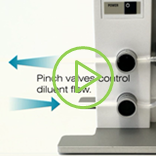
Liquid flow is controlled by pinch valves, which act on the tubing from the outside and do not come into contact with the liquid. The tubing and dispensing nozzle can be easily removed for cleaning and sterilisation.
Which serological or graduated pipettes can be used with the Serial Diluter?
The Inlabtec Serial Diluter is compatible with standard 10 ml serological and graduated pipettes, whether made of glass or plastic. Other pipette sizes may also be used, provided that the outer diameter is between 8–15 mm and the length is between 150–350 mm.
Wide-tip serological pipettes, as commonly used in cell culture applications, should not be used because their outlet may be too large for a secure connection to the Serial Diluter.
Can I leave the Serial Diluter ready for operation overnight?
The Inlabtec Serial Diluter can remain operational until the connected diluent has been used up. This allows laboratories to avoid unnecessary interruptions caused by replacing or reconnecting the diluent bottle during routine work.
The dispensing nozzle is protected by a sleeve, which reduces direct exposure to the laboratory environment and helps minimise the risk of contamination during normal operation.
As an additional precaution during longer periods of non-use, for example over a weekend, the dispensing nozzle can be parked in 70% ethanol. This helps maintain system cleanliness and further reduces the risk of contamination. For details refer to the operating instructions in the Support section.
Can the system be operated in a sterile bench and UV-sterilised overnight?
The Serial Diluter can be operated in a sterile bench, laminar flow, etc. and the device is UV-resistant for regular surface sterilisation.
What materials does the diluent come into contact with?
The diluent comes into contact with silicone, stainless steel, glass or polystyrene (depending on the 10 ml pipette used), polyethylene and polypropylene.
4. Serial Dilution Bags
Why does Inlabtec use bags instead of pre-filled disposable dilution containers?
Inlabtec uses Serial Dilution Bags because they combine the benefits of sterile single-use materials with very low material consumption.
Pre-filled disposable dilution containers can reduce preparation work, but they often require considerably more plastic, packaging, storage space and transport volume. For serial dilution, a rigid container with a screw cap is usually not required, because the dilution is typically processed immediately and not stored for a longer period.
Inlabtec Serial Dilution Bags are specifically designed for sterile filling, reliable mixing and safe sample transfer. Each bag contains only about 250 mg of polyethylene. In combination with automated diluent dispensing and integrated mixing, this reduces manual handling, material use, storage requirements and waste.
The guiding principle is: as much single-use convenience as necessary, as little material as possible.
What material are Serial Dilution Bags made of?
The Serial Dilution Bags are made of high purity virgin polyethylene (PE) under clean room conditions. The Serial Dilution Bags comply with the regulations EU No. 10/ 2011 of 14.1.2011, 1935/ 2004 of 27.10.2004 and 2013/ 2006 of 22.12. 2006 and U.S. FDA 21, CFF 04, Title 21 (plastic materials and articles in contact with food).
What is the shelf life of Serial Dilution Bags?
The shelf life at room temperature of the Serial Dilution Bags is guaranteed for five years after production, provided the box is shrink-wrapped in the protective film.
How long can an opened box of Serial Dilution Bags be used?
After removing the protective film from the packaging it is recommended to use the Serial Dilution Bags within three months.
What are the optimal storage conditions for Serial Dilution Bags?
Store protected from direct solar light at room temperature (10 – 30 °C).
Can filled Serial Dilution Bags be stored?
The used Serial Dilution Bags can be stored in the Bagshell 100030. A Bagshell is included in the scope of delivery.
What is the evaporation rate in filled and stored Serial Dilution Bags?
The evaporation rate for filled Serial Dilution Bags and dilution tubes in the refrigerator is identical with approx. 5–10 mg (µl) per 24 hours per bag or capped test tube with 9 ml of diluent.
Do Serial Dilution Bags contain substances that could inhibit bacterial growth?
Serial Dilution Bags are made of high-purity virgin polyethylene and are free of substances that could inhibit the growth of microorganisms.
How is the sterility of Serial Dilution Bags ensured?
The Serial Dilution Bags are manufactured under controlled clean conditions within a quality management system according to DIN EN ISO 13485. After packaging, the bags are radiation-sterilised using a validated process according to ISO 11137-1/-2.
The sterilisation process is validated by an independent test laboratory using dosimetric and microbiological testing. Routine monitoring supports consistent sterility of the Serial Dilution Bags at the specified Sterility Assurance Level (SAL) of 10⁻³.
How is homogeneous mixing in Serial Dilution Bags achieved?
The Serial Dilution Bags were developed specifically for automated serial dilution with Inlabtec Serial Diluters. Their geometry and positioning in the Bagholder support reliable sample addition, diluent dispensing, mixing and sample removal.
The bags are arranged in the Serial Diluter so that addition and removal take place in separate functional zones. This helps minimise carry-over from more highly concentrated sample material. The shaped lower section of the bag supports controlled liquid movement during dispensing and mixing, while the integrated mixing movement of the Serial Diluter homogenises sample and diluent directly in the bag.
This standardised mixing process replaces separate manual vortexing and reduces operator-dependent variation. With the Serial Diluter UA, mixing is triggered by moving the handle from one position to the next. With the Serial Diluter UC, mixing is integrated into the automated dilution workflow.
Homogenization performance can be verified microbiologically as described under “How can homogenization performance be assessed?” and by following the detailed instructions available under Support/Instructions.
5. Sterility and Operating Safety
How is the sterility of the system ensured?
The Serial Diluter is designed to support sterile handling during routine serial dilution. All liquid-contacting parts, including the tubing set and dispensing nozzle, can be sterilised before use according to the operating instructions. The connected diluent supply must also be sterile before operation.
During operation, the system dispenses diluent through the dispensing nozzle but does not aspirate liquid through the nozzle. Sterile filters are used for venting, helping to prevent microorganisms from entering the liquid path.
The workflow is designed so that the dispensing nozzle enters only sterile, empty bags for filling. The sample is then pipetted through a separate opening into the filled Serial Dilution Bag. When operated correctly, this separation helps prevent contact between the dispensing nozzle and sample material.
A demo video for the Serial Diluter UA shows the safety precautions.
Why can I be sure that the dispensing nozzle will not become contaminated during operation?
The Serial Diluter is designed to minimise the risk of dispensing-nozzle contamination during routine use. The dosing arm moves in one direction during the dilution series, so the dispensing nozzle remains in a process-defined sterile zone.
For filling, the dispensing nozzle enters an empty, sterile Serial Dilution Bag. The sample is then pipetted through a separate opening into the filled bag. This prevents direct contact between the dispensing nozzle and the sample.
Mixing starts only after the dispensing nozzle has left the bag and is positioned above the next sterile bag. Outside the bags, the dispensing nozzle is protected by a sleeve and is positioned so that it cannot touch non-sterile surfaces during normal operation.
As with any microbiological workflow, correct installation, sterilisation and handling remain important. When the system is operated according to the instructions, the risk of dispensing nozzle contamination is reduced to a very low level.
How can we ensure the sterility of the Serial Diluter in our lab?
Sterile handling depends on correct preparation of the liquid-contacting parts, correct connection of the diluent bottle and careful handling during installation. The procedure is comparable to setting up other sterile dispensing systems used in microbiological laboratories.
For reliable sterilisation of the tubing set and dispensing nozzle, suitable sterilisation pouches should be used to allow complete steam penetration during autoclaving. During installation, make sure that the dispensing nozzle does not touch non-sterile surfaces.
If a sterility control indicates contamination, the most likely sources to check are the diluent itself, the autoclaving of the tubing set and dispensing nozzle, the sterility of the diluent bottle and sterile filter assembly, and the handling during setup.
How can I test whether the components used were sterile and the bacterial counts are correct?
Sterility cannot be confirmed instantly during routine work. If sterility needs to be checked, perform a sterility control before starting and after completing the dilution series.
For this control, dispense 9 ml of diluent without adding a sample and plate an aliquot on a suitable culture medium. Repeat the control with the last 9 ml dispensed after the dilution series. Incubate both controls according to your laboratory procedure.
This check helps confirm that the diluent, tubing set, dispensing nozzle and setup procedure remained free of detectable contamination during use.
Are the sterile filters hydrophobic or hydrophilic, and are they autoclavable?
The PTFE (Teflon) filters used are hydrophobic and autoclavable. Difference between hydrophobic and hydrophilic filters: training video
Attention: Do not install hydrophilic filters on bottles with diluent or on the Serial Diluter.
6. Accuracy, Standards and Verification
Does the Serial Diluter improve the reliability and accuracy of test results?
The Serial Diluter helps improve the reliability and consistency of test results by standardising key steps of the serial dilution process. This reduces the influence of sample throughput, time pressure, unplanned workload peaks and individual working technique.
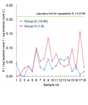
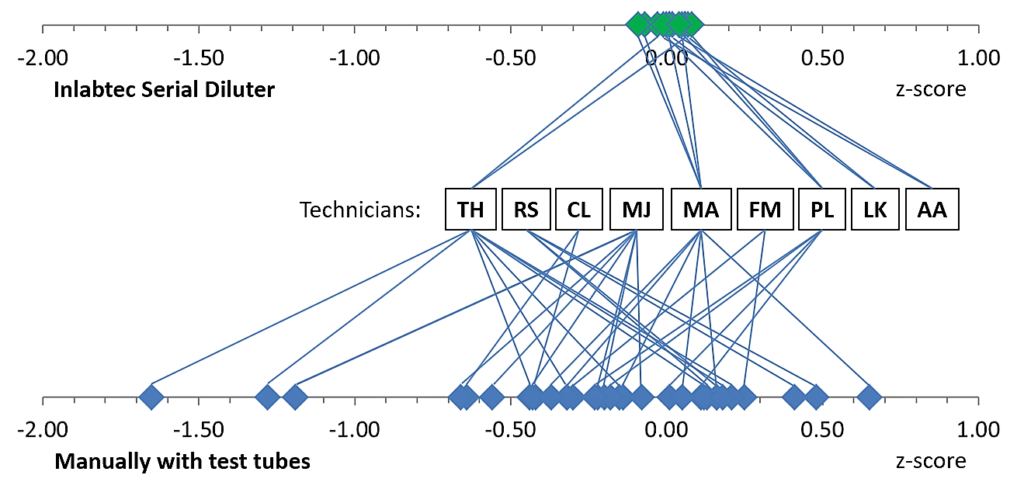
The interlaboratory test evaluation shown below demonstrates z-score values within ±0.1 for users working with the Serial Diluter. This indicates that users achieved highly consistent test results, regardless of their level of experience or individual differences in working technique.
What does ISO 7218:2024 require for serial diluters?
ISO 7218:2024, Clause 6.4.4.4, specifically addresses the calibration and verification of serial diluters. Dispensed volumes must be checked gravimetrically, and homogenization performance must be assessed initially and at defined intervals using comparative tests.
The standard does not prescribe a specific test procedure or numerical acceptance criterion for homogenization performance. Each laboratory therefore defines the scope, representative test conditions, acceptance criteria and monitoring intervals based on the intended use and a risk-based approach.
Inlabtec provides practical procedures for the microbiological assessment of homogenization performance and for an additional mechanical check of mixer speed and mixing time (see support/instructions)
Which directives and ISO standards are supported?
The Inlabtec Serial Diluter is designed for preparing decimal dilutions using 1 mL of sample and 9 mL of diluent in accordance with the principles of ISO 6887-1:2017, including Amendment 1:2024.
ISO 7218:2024, Clause 6.4.4.4, specifically addresses the calibration and verification of serial diluters. It includes requirements for checking dispensed volumes and homogenization performance.
The suitability of the Serial Diluter for a specific application must be verified by the laboratory under its own operating conditions.
Can the Inlabtec Serial Diluter be used for FDA BAM methods?
The Inlabtec Serial Diluter performs ISO-style serial decimal dilutions with 1 ml sample and 9 ml diluent. This gives the same 1:10 dilution factor as 10 ml + 90 ml dilutions used in some FDA BAM methods.
If a specific FDA BAM method or accredited laboratory procedure requires 10 ml + 90 ml dilution steps, these should not be replaced by 1 ml + 9 ml dilutions without documented verification and, where required, customer or regulatory acceptance.
Where 1 ml + 9 ml serial dilutions are permitted, the Serial Diluter can provide a faster, more compact and more resource-efficient workflow for routine plate count applications.
Can ISO-style 1 ml + 9 ml serial dilutions be used instead of FDA BAM 10 ml + 90 ml dilutions?
Some FDA BAM methods use large-volume decimal dilution steps, such as 10 ml sample into 90 ml sterile diluent. The Inlabtec Serial Diluter is designed for ISO-style serial decimal dilutions using 1 ml sample and 9 ml diluent.
Mathematically, both formats produce the same 1:10 dilution factor:
10 ml + 90 ml = 1:10
1 ml + 9 ml = 1:10
For well-homogenised plate count applications, changing only the subsequent serial dilution steps from 10 ml + 90 ml to 1 ml + 9 ml is expected to have a low risk of deviating results, provided the smaller 1 ml aliquot is representative for the tested matrix and application.
However, laboratories working under an FDA BAM-based method, accreditation scope, customer requirement or regulatory specification must follow the dilution format required by that method. If 10 ml + 90 ml dilution steps are mandatory, they should not be replaced by 1 ml + 9 ml dilutions without documented verification and, where required, customer or regulatory acceptance.
Where ISO-style 1 ml + 9 ml serial dilutions are permitted, they can reduce diluent consumption, container volume, preparation work, handling time, sterilisation requirements, storage space, transport volume and waste by approximately a factor of ten at each serial dilution step.
This conclusion applies mainly to plate count applications. MPN methods should be evaluated separately because smaller aliquot volumes may increase sampling variability, especially at low bacterial concentrations or close to detection limits.
How was the performance of the Serial Diluter assessed during development?
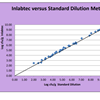
During development, serial dilution with the Inlabtec Serial Diluter was compared with the conventional dilution tube method in accordance with the principles of ISO 6887-1. The comparison was performed by the Zurich University of Applied Sciences in Wädenswil.
Independent laboratories have subsequently performed their own comparative studies using different food samples. One example is the testing performed by Campden BRI, in which results obtained with the Serial Diluter were compared directly with those from the conventional dilution tube method.
Successful proficiency testing results obtained by accredited laboratories provide additional evidence of the Serial Diluter’s suitability as part of the overall examination procedure.
Are instructions available for checking the Serial Diluter according to ISO 6887-1 and ISO 7218:2024?
Yes. The following instructions are available under Support/Instructions:
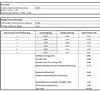
- Gravimetric verification of the dispensed volume, including an Excel evaluation template
- Verification of homogenization performance by comparing microbial counts before and after additional manual mixing
- Mechanical mixer function check using a smartphone accelerometer and the phyphox app
The mechanical mixer function check provides indirect evidence of correct mixer operation but does not replace the microbiological assessment of homogenization performance.
The procedures and acceptance criteria provided by Inlabtec are practical internal specifications. Where they are not defined by the applicable standard, the laboratory remains responsible for establishing appropriate criteria and monitoring intervals for its intended use.
What is the difference between verification and validation of a testing method?
Method validation and method verification are distinct but related processes used to ensure the reliability of testing methods.
Method validation is performed when a new or significantly modified method is introduced. It evaluates whether the method is suitable for its intended purpose and meets defined performance criteria, such as accuracy, precision and sensitivity.
Method verification is used to confirm that a previously validated or standardised method performs as expected in a specific laboratory setting. This is typically required when a laboratory uses a method for the first time or when changes to the method, equipment or workflow could affect performance.
In simple terms, validation demonstrates that a method is suitable for its intended purpose, while verification confirms that an established method works correctly under the conditions of a specific laboratory.
Do I need to verify or validate the Serial Diluter?
Equipment that can affect test results must be verified before use in an accredited laboratory. When introducing the Serial Diluter, the laboratory must demonstrate that it is suitable for its intended application and produces valid results under the laboratory’s own conditions.
Initial verification typically includes a comparison between results obtained with the Serial Diluter and those obtained with the laboratory’s previously established serial dilution method.
Method validation may be required if the Serial Diluter is used in a way that represents a new or significantly modified examination method. The laboratory determines the required scope based on its accreditation, intended applications and risk assessment.
How can I verify the Serial Diluter?
Verification may include the following complementary elements:
Comparison with the established laboratory method
For initial verification, parallel aliquots of the same homogenized samples are tested using both the Serial Diluter and the laboratory’s previously established serial dilution method under otherwise consistent conditions. This demonstrates that the Serial Diluter provides comparable results for the intended application.
Verification of dispensed volumes
The volumes dispensed by the Serial Diluter are checked separately by gravimetric measurement, as described in the operating instructions.
Assessment of homogenization performance
Microbial counts before and after additional manual mixing of the same bag contents are compared. No relevant change indicates sufficient automatic homogenization under the conditions tested. Inlabtec proposes an internal acceptance criterion of 0.3 log₁₀. ISO 7218:2024 does not specify a numerical acceptance criterion.
Mechanical mixer function check
Mixer speed and mixing time can additionally be measured using a smartphone accelerometer and the phyphox app. This provides indirect evidence of correct mechanical mixer function but does not replace the microbiological assessment.
The laboratory defines the representative samples, test conditions, acceptance criteria and monitoring intervals based on the intended use and a risk-based approach.
What acceptance criterion can be used for the initial method comparison?
For an initial comparison between the Serial Diluter and the laboratory’s previously established dilution method, an absolute difference of up to 0.5 log₁₀ may be used as a practical acceptance criterion for microbial count results.
A limit of 0.5 log₁₀ is used in ISO 16140-3:2021 for assessing the estimated bias during the single-laboratory verification of quantitative microbiological methods. Its application to the comparison of serial dilution procedures is analogous.
How can homogenization performance be assessed?
Homogenization performance can be assessed microbiologically by comparing microbial counts before and after additional manual mixing of the same bag contents.
After the selected dilution levels have been plated following automatic homogenization, the remaining contents of each bag are aspirated as completely as possible into a sterile 10 mL pipette and dispensed back into the same bag, resulting in vigorous additional mixing. The dilution levels are then plated again.
If the additional mixing causes no relevant change in the microbial count, automatic homogenization is considered sufficient under the conditions tested. Inlabtec proposes an internal acceptance criterion of 0.3 log₁₀.
Detailed instructions are available under Support/Instructions.
How can the mechanical performance of the mixer be checked?
Mixer speed and mixing time can be checked using a smartphone accelerometer and the free phyphox app. The smartphone is placed on the bag holder while several mixing operations are recorded. The mixing time is determined from the recorded acceleration signal, and the mixer speed is calculated from the number of detected cycles.
A complete mixing operation at the specified speed and duration confirms that the mixer is operating with the required mechanical parameters. This provides indirect evidence of consistent mixer function and, with an unchanged device configuration, consistent homogenization performance.
For detailed instructions and acceptance criteria, see Mechanical Function Check of the Inlabtec Serial Diluter Mixer under support.
Is there a quality certificate for the Serial Diluter?
The CE certificate for the Serial Diluter is in the manual.
What is the difference between accuracy and precision?
Accuracy describes how close the average measured value is to the target or reference value. The difference between the average measured value and the target value is referred to as systematic error or bias.
Precision describes how close repeated individual measurements are to each other. A common statistical measure of precision is the standard deviation, which reflects random variation between measurements.
How accurately can the Serial Diluter dispense?
The dispensed volume in the Serial Diluter is defined by the pipette in combination with an optical sensor. The optical sensor detects the liquid level in the pipette at the selected volume position.
The accuracy of the dispensed volume depends primarily on the accuracy of the pipette scale or graduation, the correct positioning of the optical sensor and the connection-related volume offset between the pipette outlet and the Serial Diluter connection.
This offset is constant for a given setup and typically lies in the range of 50–100 µl. Where relevant, it should be taken into account when setting, checking or calibrating the dispensed volume.
How accurate are 10 ml pipettes?
The indicated volume inaccuracy for plastic serological pipettes is approximately ± 2%, while for glass graduated pipettes, it is ± 0.5% for class AS and ± 1% for class B.
How can a pipette scale calibration be performed?
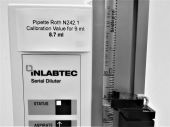
To ensure accurate and consistent results, it is recommended to perform a quick check of the 10 ml pipettes in use. This check, also referred to as pipette scale calibration, helps identify any systematic deviation of the pipette scale and establish the correct optical sensor position for the desired 9 ml volume used in serial dilutions.
The calibration can be performed quickly using a balance, following the instructions available in the Support section. Once a pipette has been checked, the same sensor setting can normally be used for other pipettes from the same lot number, simplifying correct volume setting when installing additional pipettes.
How can a shortened pipette check be performed?
For a quick check, detach the silicone connector from Tubing Set 100011 and attach it to the pipette outlet. Using a pipetting aid, dispense liquid into a vessel on a balance or into a graduated cylinder. Determine the position on the pipette scale that corresponds to a dispensed volume of 9 mL with the silicone connector attached. Record this scale position and align the Serial Diluter’s optical sensor accordingly. The same setting can normally be used for pipettes from the same production lot.
How can I verify that the set volume was actually dispensed?
The dispensed volume should be verified gravimetrically, as described in the operating instructions. A filled bag is weighed, and the measured mass is converted into volume using the density of the diluent or the applicable laboratory procedure.
The meniscus position in the pipette can be checked visually before dispensing as a routine plausibility check. However, visual inspection does not replace documented gravimetric verification.
An Excel template for evaluating the gravimetric measurements is available under Support/Instructions.
What is the best way to dispense into a measuring cylinder for verification?
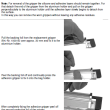
To pipette into a measuring cylinder, remove the dispensing nozzle from the Bagholder and position it above a 10 ml measuring cylinder. Trigger dispensing by moving the dosing arm of the Bagholder UA to the next position. To reduce the risk of contamination during verification, consider attaching a dispensing nozzle holder 140015 to the Serial Diluter (see picture below).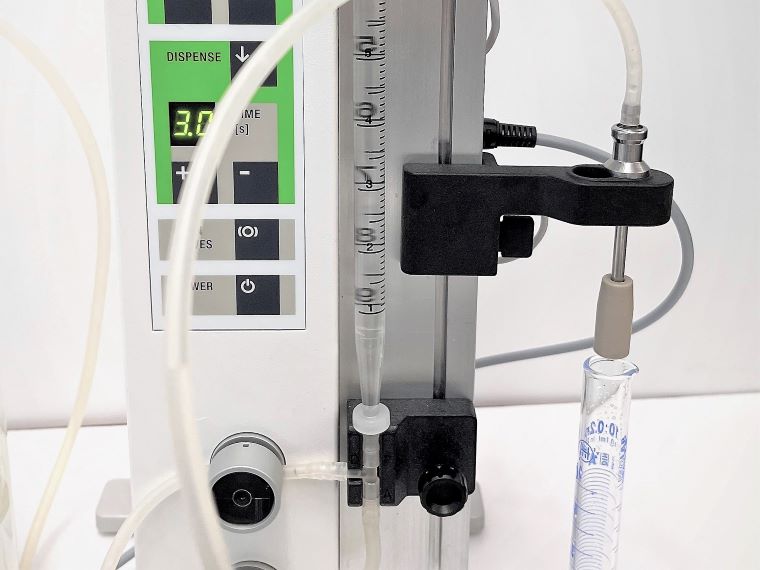
7. Cleaning, Maintenance and Service
How do I clean the Serial Diluter?
To clean the device surfaces, use a commercially available cleaner or soapy water. For disinfection, use 70% ethanol.
To ensure reliable and consistent results, the liquid-contacting parts of the Serial Diluter must be properly cleaned and sterilised. After use, replace the diluent with water and rinse the system before removing the tubing set and dispensing nozzle. The tubing set and dispensing nozzle can then be cleaned and sterilised according to the operating instructions.
For more detailed instructions, please refer to the operating manual or the training videos available on support.
Are there components that need to be replaced regularly?
To support sterility and reliable operation, the sterile filters on the diluent bottles should be replaced after eight autoclaving cycles, or according to the filter manufacturer’s instructions.
In addition, the sterile filter on the Serial Diluter should be replaced every 6–9 months. Regular filter replacement helps maintain proper venting, supports system sterility and reduces the risk of contamination during routine use.
How reliably does the opening of Serial Dilution Bags work, and is there wear?
A microstructured silicone adhesion gripper is used to open the Serial Dilution Bags. The opening process causes very little mechanical wear during normal operation.
If the adhesive force decreases due to dirt or particles on the surface, the adhesion gripper can first be cleaned dry by pressing standard office adhesive tape onto the gripper surface and peeling it off again to remove adhering particles. If required, the gripper can also be cleaned with water, 70% ethanol or another suitable cleaning solution.
If sufficient adhesive force is not restored after cleaning, and the gripper has been in use for 3–6 months, it should be replaced.
Replacement is simple, and training videos are available to guide users through the process on support.
What maintenance and service is required for the Serial Diluter?
The Serial Diluter requires only limited routine maintenance. The device monitors operating conditions such as blocked filters or leaks and informs the user when attention is required.
The main user-replaceable components are sterile filters and, if required after extended use, the adhesion gripper used to open the Serial Dilution Bags. If a technical issue cannot be resolved by routine checks, trained distributors and service partners are available to support the laboratory.
How is product service ensured?
Inlabtec products are sold through authorised distributors, who can perform all service work. The Serial Diluter is based on very solid, proven technology, which keeps service work to an absolute minimum.
How long is the warranty period for the Serial Diluter?
The warranty period for all device components is two years. Details can be found in our AGB (General Terms and Conditions).
8. Sustainability and Resources
Is it ecologically sensible to use Serial Dilution Bags?
Serial Dilution Bags use only about 250 mg of polyethylene per bag. Compared with pre-filled disposable dilution containers, they can reduce plastic waste by up to 90%, depending on the reference product and laboratory workflow.
The ecological benefit is not limited to the low material mass of the bags. Serial Dilution Bags also reduce transport and storage volume and eliminate tube preparation, filling, washing and autoclaving before use. This can reduce water, detergent, energy and handling requirements in routine serial dilution workflows.
The energy balance depends on laboratory procedures, autoclave efficiency, batch size and local waste treatment. As an indicative value, the material energy footprint of a Serial Dilution Bag is approximately 20–25 kJ per bag, with possible energy recovery of up to about 5–8 kJ per bag where efficient waste-to-energy systems are used.
How does the environment benefit from the use of the Serial Diluter?
The environmental benefit comes from the combination of low-material Serial Dilution Bags and the elimination of tube-related preparation and reprocessing steps. Each bag uses only about 250 mg of polyethylene, while pre-filled disposable dilution containers usually require substantially more plastic and transport volume.
Serial Dilution Bags eliminate the need to wash, dry and autoclave reusable dilution tubes before they can be used again. This can reduce water consumption, detergent use, energy demand and preparation-related handling.
Compared with pre-filled disposable dilution containers, Serial Dilution Bags can reduce plastic waste by up to 90%, depending on the reference product and workflow. The overall environmental balance depends on local disposal, recycling and waste-to-energy options.
How much plastic is used per Serial Dilution Bag?
Each Serial Dilution Bag is made from approximately 250 mg of polyethylene (PE). This very low material use is a key reason why Serial Dilution Bags can substantially reduce plastic waste compared with pre-filled disposable dilution containers.
What is the energy consumption for producing Serial Dilution Bags?
The material energy input of a Serial Dilution Bag is approximately 20–25 kJ per bag, based on the production of virgin polyethylene. Because each bag contains only about 250 mg of polyethylene, the material input per dilution remains low.
Where efficient waste-to-energy systems are used, up to about 5–8 kJ per bag may be recovered during incineration. The estimated net energy per dilution is therefore approximately 12–20 kJ where such energy recovery is available.
By comparison, reusable glass dilution tubes require repeated washing and autoclaving before reuse. Typical washing and autoclaving energy is estimated at approximately 9–16.2 kJ per tube and reuse cycle, depending on laboratory procedures, equipment efficiency and batch size.
Can Serial Dilution Bags be recycled?
Serial Dilution Bags are made from polyethylene and can, in principle, be recycled with other polyethylene waste. In practice, recycling depends on sample contamination, decontamination procedures, biosafety requirements and local recycling options.
For microbiological laboratories, safe handling and disposal according to local laboratory procedures and waste regulations remain essential. Where recycling is not practical, energy recovery may be an option depending on local waste treatment infrastructure.
From a resource perspective, reducing plastic mass at the source is often the most robust strategy. This was one of the key reasons for developing the low-material Serial Dilution Bag format.
If you need additional information, please contact us via contact form. We are happy to be of service.