Laboratory personnel accustomed to conventional methods may wonder whether serial dilutions without a Bunsen burner can be performed safely. A 2026 study published in Microbiology Spectrum provides relevant new evidence: a Bunsen burner does not generally reduce the deposition of airborne microorganisms, and working without a flame does not automatically compromise aseptic safety.
Does the flame create a sterile working zone?
Bunsen burners are used not only to sterilize inoculation loops or flame vessel openings. They are also believed to create an aseptic zone by generating upward air currents that carry airborne contaminants away from the work area.
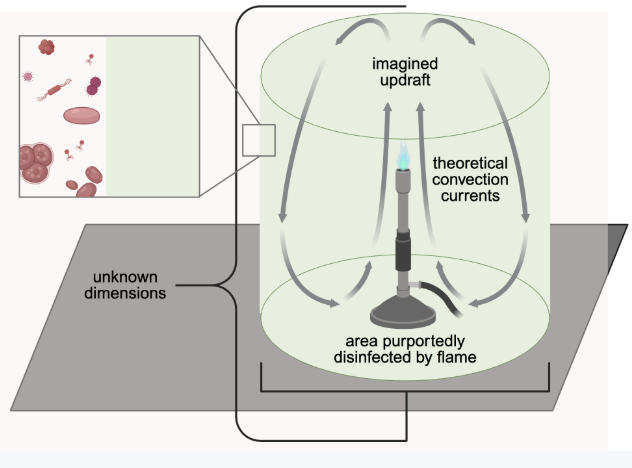
Source: DeVincent et al. (2026), Microbiology Spectrum, CC BY 4.0. Created with BioRender. DOI: 10.1128/spectrum.01028-26.
To test this assumption, researchers compared microbial deposition on open agar plates positioned ten centimetres from either an active or inactive Bunsen burner. They investigated dry and wet microbe-containing particles as well as two burner sizes.
On average, the active flame did not significantly reduce microbial deposition under any of the conditions tested. A modest benefit was observed only at very high levels of dry airborne contamination. Below this level, the flame could even increase particle deposition. No relevant protective effect was found for wet particles, and allowing the burner to operate for longer before exposure did not improve the results.
The authors therefore concluded that Bunsen burners do not universally reduce airborne contamination. Their findings do not support the general assumption that a sterile working zone exists around the flame.
Serial dilutions without a Bunsen burner
The Inlabtec Serial Diluter is designed to perform serial decimal dilutions using pre-sterilized Serial Dilution Bags instead of conventional dilution vessels. Diluent dispensing and homogenization are standardized and automated.
The study did not investigate the Serial Diluter and therefore does not establish whether its use directly affects contamination rates compared with other methods. However, the findings challenge the assumption that working without a Bunsen burner inherently compromises aseptic safety. This is consistent with the practical experience of laboratories using the Serial Diluter: an open flame is not required to create a presumed aseptic zone around the workstation.
This should be distinguished from procedures in which a flame is used specifically to sterilize instruments. Whether such steps are necessary depends on the analytical method and the laboratory’s internal procedures.
Aseptic technique remains essential
Eliminating the Bunsen burner does not replace good aseptic practice. Reliable results still depend on:
- a clean, controlled working environment;
- disinfected work surfaces;
- sterile consumables;
- correct pipetting technique;
- avoiding contact with sample- and pipette-contacting areas; and
- minimizing unnecessary movement during sample processing.
The Serial Diluter supports this approach through a clearly defined and reproducible workflow. Automation also reduces manual handling steps and the associated potential for operator error.
A safer, modern workflow
A flame-free workstation reduces the risk of fires, burn injuries to laboratory personnel, and damage to equipment, cables or laboratory furnishings. It is particularly beneficial where alcohol-based disinfectants, plastic consumables and electronic equipment are used nearby. Avoiding an open flame also eliminates unnecessary heat generation and the associated cooling demand.
The study by DeVincent et al. shows that aseptic safety does not result from the presence of a Bunsen burner alone. It depends on sterile materials, correct working techniques, controlled laboratory conditions and standardized processes.
The Inlabtec Serial Diluter enables laboratories to perform serial dilutions without a Bunsen burner using an efficient, standardized and reproducible workflow – while reducing manual workload and material consumption.
Source: DeVincent K. et al. (2026): As a component of aseptic technique, Bunsen burners do not universally decrease deposition of microbe-containing particles. Microbiology Spectrum. DOI: 10.1128/spectrum.01028-26